
“Good morning, how are we feeling?”
That simple question has become a rhythm in my home and in my work. Recently, my son overheard one of my morning talks and said, half-jokingly, “Mom, you should be a therapist. You’re always asking people how they feel.” His comment made me smile and pause for thought. I told him: I care deeply about how we feel because, whether we realize it or not, we usually live from that place.
Scripture puts it plainly: “Above all else, guard your heart, for everything you do flows from it” (Proverbs 4:23 NIV).
That verse has followed me for years—not as a slogan, but as a lens. It shapes how I parent, lead, listen, and pursue the dreams God has placed in my heart. Yet, the word heart itself can mean very different things depending on who you ask.
What Do We Mean When We Talk About the Heart?
Not long ago, I reconnected with an old friend—talented, and now a principal investigator. As we talked, I mentioned the importance of the heart. He said he didn’t quite understand what I meant. For him, the heart was an organ. A pump. Nothing more.
He’s not alone in thinking this way.
Biologically speaking, he’s absolutely right. The heart is an organ that pumps blood and sustains physical life. But theology, psychology, and lived human experience invite us to see much more.
In theology, the heart, may also be called the soul in this context, is not limited to emotion. It represents the entire inner self—the core of a person’s being. It includes the mind, will, conscience, desires, and motivations. The heart is the control center from which choices are made and lives are directed. It is where one encounters God, wrestles with truth, and allows transformation to take place. Scripture speaks of God writing His law on hearts, of hardened hearts, of pure hearts, and of hearts that overflow with love or bitterness. In this sense, the heart is not just something we have—it is somewhere we live from.
Psychology and modern science, interestingly, are catching up to what ancient wisdom has long suggested. The heart is now understood as a sophisticated information center with its own neural network. Through the heart-brain connection, signals from the heart influence emotions, cognition, decision-making, and social connection. Measures like heart rate variability (HRV) show how emotional regulation, stress, and even relational safety are deeply tied to heart function. Our emotional lives leave an imprint on our bodies, behaviors, and health.
Different disciplines speak different languages, but they are often describing the same reality from different angles.
Do We Understand The Language?
Understanding only the area we are trained in is rarely enough. Life is interdisciplinary. People are complex. Emotions, beliefs, values, biology, culture, and experience all intersect.
I often say that different subject areas are like different languages. To truly understand people, we must be willing to learn their language. And language is not just spoken, it is expressed through behavior.
This shows up clearly in our children.
They have very different temperaments. One tells the truth boldly, whether you like it or not. The other tells the truth with care and tenderness. When something is off, I can usually tell without a single word being spoken. One child won’t eat, even though she normally eats everything in sight. The other won’t share. By the time those behaviors surface, the real issue is not discipline, it’s emotion.
Although they have somewhat grown out of this pattern, children are often far more honest than adults. They show us what we have learned to hide.
What Do We Mean When We Say “Fine,” “Good,” and Everything We Don’t Say?
Back to that daily question: How are we feeling?
Most answers are predictable. “Fine.” “Good.” “Well.” I give those answers myself until I catch it.
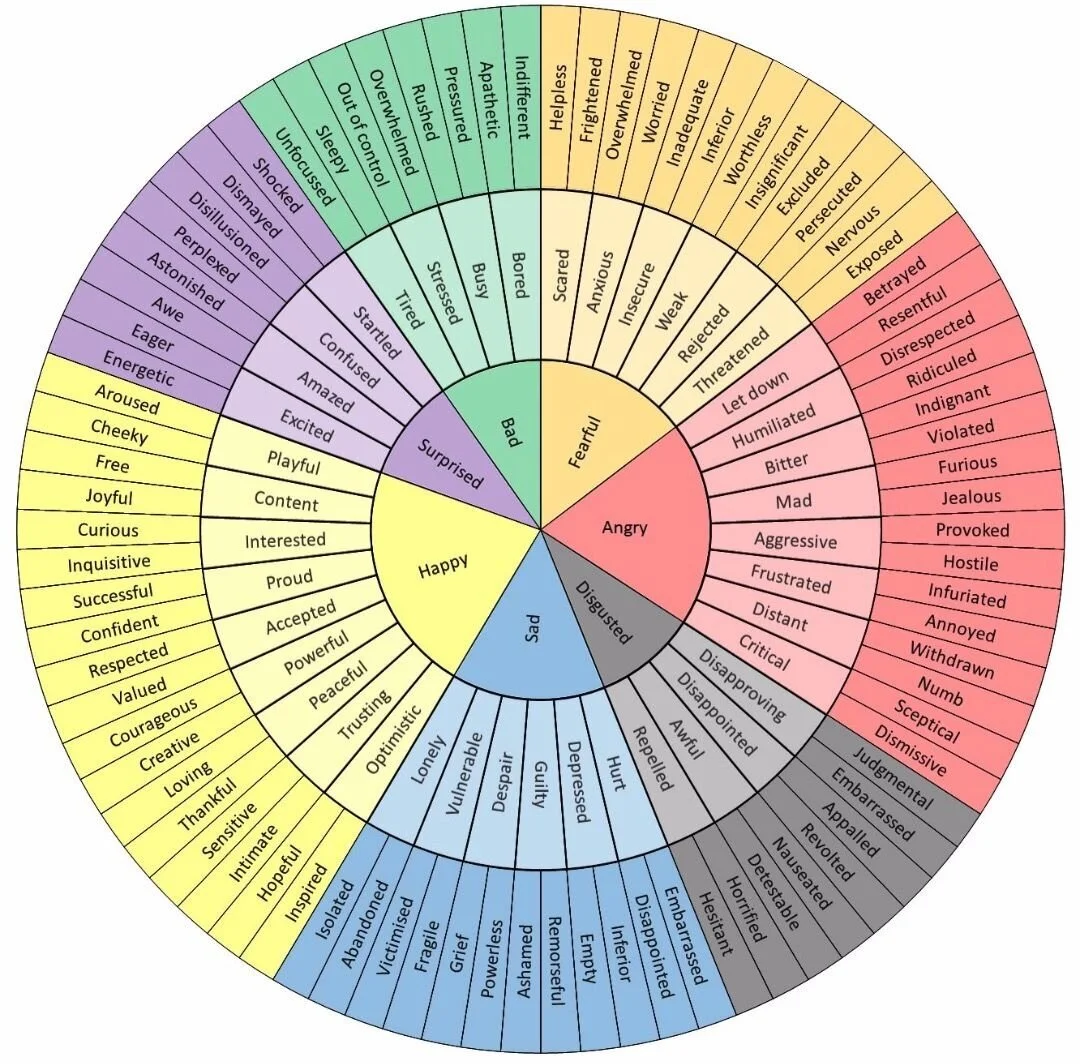
The Emotion Wheel: visual tool designed to help people identify, label, and understand their emotions. Image source.
Have you ever noticed how, when we feel upset or overwhelmed, we can unconsciously expect the whole world to carry that weight with us? A small frustration turns into a mountain. A fleeting emotion becomes a defining moment. We make mountains out of molehills, not because the situation is massive, but because the emotion underneath hasn’t been acknowledged or processed.
What happens when we don’t understand our emotions?
Emotions don’t disappear. They leak.
They show up as worry, blame, irritability, withdrawal, or control. Over time, these unprocessed emotions affect our hearts spiritually, emotionally, and even physically. Jesus spoke about “the worries of life” choking growth. Many of those worries begin as unmanaged emotions that quietly take up residence in our inner world.
And when that happens, it becomes harder to pursue dreams, take risks, or walk fully in purpose.
Can We Pause Long Enough To Recognize That Something Is Off?
Sometime ago I started a podcast called “Be Still And Grow,” it is how I have learned to live my life. We have paused this podcast until further notice. I also take one day during the week to simply pause. Because I usually feel overwhelmed, drained, and burnout. I was a workaholic; to do this took intentionality.
Learning to identify, communicate, and process our emotions is not a weakness; it is wisdom, it is emotional intelligence.
We do not need everyone else to feel what we are feeling. We do not need to make a big issue out of everything. What we need is to pause. The moment of honest self-inquiry: How am I really feeling?
Sometimes we won’t know the answer right away. But even recognizing that something is off is powerful. Awareness is often the first step toward alignment.
We live from how we feel and think—whether we admit it or not. That is why checking in with ourselves regularly is responsible.
What Have We Learned Through Our Experiences? Listening Across Cultures
One of the gifts I recognize in my own journey is the ability to communicate with people from all walks of life. My experiences across various countries, cultures, and faith contexts, combined with intuition and motherhood, have shaped this deeply.
I have found that believers and non-believers, church and unchurched, people of different religions, ethnicities, and backgrounds, are often far more alike than different. The difference is usually language.
If we take the time to listen—truly listen—we begin to hear the heart beneath the words.
In our book, I share my experience in Peru. I loved it deeply, even though I could not speak Spanish. Understanding people who speak another language requires humility and attention. Listening becomes essential.
Yet many of us struggle to listen, not because we don’t hear, but because we already think we know the answer or we get distracted. When we ask questions with predetermined conclusions, we stop connecting. And without connection, transformation rarely happens.
Thought Life, Resistance, and the Inner Battle
During my PhD journey, I became acutely aware of how important our feelings and thought life is to succeeding at anything meaningful.
Even when external distractions are removed, no television, no social media, no children calling for attention, we still have our minds to contend with. While writing my thesis, all kinds of thoughts surfaced: doubt, fear, comparison, the temptation to quit. These thoughts were not unique to me; they are part of the human experience.
Add to that the complexity of living among people with different personalities, temperaments, and ways of giving and receiving love, and life can feel complicated very quickly.
We are not called to figure everyone out. That is not our assignment. Discernment matters, but obsession does not. Our responsibility is to live from our core—to know what we believe, value, and stand on—and to love others as best we can with the guidance of the Holy Spirit.
Can Our Character Carry the Dream?
It is wonderful to be talented. Skill opens doors. But character, attitude, and behavior determine how long we stay in the room or if we fulfill the dream we were placed to do.
This is true in personal life, professional life, leadership, and relationships.
Dreams, ideas, visions—I believe God gives them to all of us. These dreams may come as goals, creative ideas, deep desires, or even images that stir us while we are awake or asleep. They are given to the saved and unsaved alike.
Often, they begin small. Quiet. Easy to dismiss.
Yet Scripture reminds us that God prepared good works for us to do before we arrived here. I believe the dreams He places within us are connected to those prepared works. Pursuing them leads us into the life we were created for—the life we long for, even when we can’t fully articulate it.
Still, dreams stretch us. They require growth. And because we don’t know the path, they can feel risky.
Along the way, there will be obstacles. Disappointments. Detours.
That is why understanding how to process emotions and honoring the heart-mind connection is not optional. It is essential.
Living from the Inside Out
When we guard our hearts, we are not closing ourselves off from life, we are not building walls. We are choosing to steward what flows through us into the world despite our situation.
This is the work I return to again and again—in my writing, my coaching, and my conversations. Creating space for awareness. Not forcing outcomes, but empowering people to reconnect with their core.
If this reflection resonates with you, pick up a copy of the book with these themes: dreams, heart alignment, purpose, and the inner work required to live fully. It is written as a companion, not a command. An invitation, not a formula.
And if you find yourself wanting guidance as you navigate your own inner landscape—your emotions, beliefs, dreams, and next steps—that is the work I walk with people through every week.
Because when we learn to live from the inside out, everything else begins to align.
Above all else, guard your heart. Everything flows from there.
With grace and growth,
Sanchia and team.
Audio Version
Please listen to our podcast Be Still And Grow : Guarding Your Heart
Video Version
Please watch our full length of Be Still And Grow. Guarding Your Heart: Why Everything Flows from Within