
What’s Your Favorite Food?
What’s your favorite food?
How far would you travel to get it?
We need not scroll on social media for more than a minute before seeing food reviews with thousands of likes and comments. People travel across cities, sometimes across countries, just to try a meal or visit a restaurant they saw online.
We love food.
Perhaps because of my Jamaican background, I have noticed how deeply food shapes identity. Jamaican food is loved across races, cultures, and nations. Despite cooking at home, many of us seek the Jamaican flavor when we go out. We drive miles for jerk chicken or curried goat with rice and peas. We wait in long lines and spend more than planned.
Because food is not just nourishment.
It is identity.
It is pride.
Sometimes, it is status.
Anthropologists have long recognized food as a marker of belonging and cultural meaning. Claude Fischler described eating as both a biological and social act, “we become what we eat,” not only physically but culturally (Fischler, Social Science Information, 1988).
In many Caribbean homes, cooking becomes a language of love. Foods, particularly meats, must be properly washed, seasoned, and slow-cooked with intention. Yet not everyone expresses care through cooking. Some grow food, some innovate around food, some connect people through conversation, and some simply enjoy sharing meals.
So the question becomes:
Should cultural expectations, even good ones, determine our worth, relationships, or destiny?
The Journey for What We Already Have
Last summer, a friend invited me to dinner. I agreed quickly because I was finishing work and needed to eat. I did not ask many questions.
Hunger makes us impulsive sometimes.
After nearly an hour and a half of travel and getting lost, I finally arrived.
It was a Jamaican restaurant.
I remember thinking, “All this way for Jamaican food?”
I love Jamaican food. But, many restaurants were closer to home. We traveled farther, paid more, and endured inconvenience for something already accessible.
The irony stayed with me.
The friend I met clearly understood her purpose. She could articulate it beautifully, yet hesitated to step into it, while making plans for big moves, new cities, and future dreams.
And I wondered:
How often do we exhaust ourselves searching far away for what is already within reach?
Psychological research shows that humans frequently overvalue distant rewards while overlooking present opportunities, a phenomenon known as “distance bias” (Liberman & Trope, 2014).
Are we sometimes blind to opportunities that are already available in plain sight?
Food as Comfort, Culture, and Connection
Food carries memory.
For immigrants, food feels like home. The moment we see a Jamaican restaurant, something inside us relaxes.
“Finally, real food.”
Food reconnects us to language, laughter, and belonging. Familiar foods reduce stress and reinforce identity during transition and migration.
When I traveled internationally, exploring food became an adventure. I connected with people through meals. In Peru, after six months abroad, a friend asked what I would miss most.
I laughed and said, “The food.”
Of course, I would miss the people, too, but food had become the doorway to connection.
Yet when I returned home, a deeper hunger emerged, one that food could not satisfy.
Because food fills the stomach.
But sometimes the soul remains empty.
Could our attachment to comfort be masking a deeper spiritual hunger?
When Food Doesn’t Satisfy
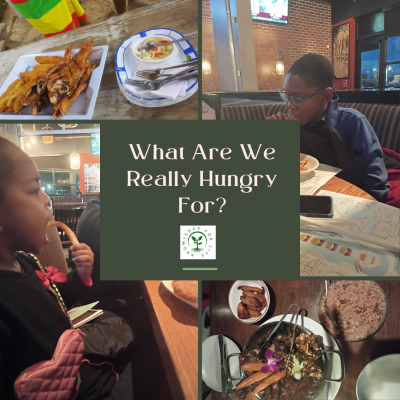
Recently, we visited a neighborhood restaurant and ordered everything the children loved — tacos, burgers, wings, fries, and onion rings.
But my son barely ate.
He was quiet.
He had missed a school dance he wanted to attend, and suddenly he began to cry. I let him cry. Silence does not always mean peace; sometimes it is a signal asking to be seen. He was also complaining of being bored.
All his favorite foods were in front of him, yet nothing satisfied him.
A week later, he presented a school project and was joyful, energized, alive.
That moment taught me something profound:
When children are growing into their strengths – creating, speaking, and expressing – food becomes secondary. But when expression is suppressed, appetite changes.
These observations are confirmed by research in developmental psychology, that emotional fulfillment strongly influences eating behavior in children (Birch, 2007).
It made me wonder:
What if our adult dissatisfaction is not about what we lack externally, but about gifts within us waiting to be expressed?
Is our hunger physical, or is it a longing to become who we were created to be?
Appetite vs. Calling
There was a season when I felt constantly hungry. I ate often, yet never felt satisfied.
Eventually, I realized:
I was not hungry for food.
I was hungry for meaning.
Human beings are not only physical. We possess body, soul, and spirit. We know how to feed our bodies, and some of us know we need to continue learning, but many of us neglect our spiritual hunger.
Scripture describes people whose “god is their belly” (Philippians 3:19) — lives driven by appetite and comfort rather than calling.
Food gives immediate satisfaction.
Purpose requires faith.
Are we feeding temporary appetites while starving eternal purpose?
Building — But What and For Whom?
Many of us pride ourselves on hard work. Especially within Caribbean culture, diligence is honorable.
But one realization changed my perspective:
We often spend our lives building other people’s dreams without a thought about our own.
I spoke to an engineer not long ago, he was forced to return to work after retirement savings disappeared, not his fault. Another brilliant professor worked tirelessly until his death in his eighties, leaving family struggles behind.
These stories forced me to ask:
We work hard and plan financially for retirement, but do we prepare spiritually and psychologically for purpose?
We do not retire from purpose.
We continue to grow into it, building legacies for future generations.
What are we building — and who ultimately benefits from it?
When Survival Becomes Identity
When I first arrived in the United States with degrees and experience, I adopted a survival mindset: find a job. It is the culture.
In doing so, I forgot my gifts, strengths, passions, personality, and experiences. and my purpose — consulting, strategy, helping organizations grow from within.
That was self-abandonment.
At the same time, many small businesses struggled yet resisted transformation. Survival had become identity.
Nations experience this too. Without developing people, financial resources alone cannot produce growth. Development research repeatedly shows human capital — not money — drives sustainable progress (Manuelli and Seshadri 2014).
Sometimes our expectations are dismantled for us to rediscover who we truly are.
Not every opportunity is aligned with who we are.
Some distractions arrive dressed as opportunities.
Have we become so accustomed to surviving that we have forgotten how to live purposefully?
What Are We Really Hungry For?
The thief comes only to steal and kill and destroy; I have come that they may have life, and have it to the full (John 10:10).
Could food our our lust for pleasurable things be the enemy that is blocking us from real abundance?
Our bellies are full, yet many remain hungry.
Maybe we are not searching for food at all.
Maybe we are searching for:
Esau traded his birthright for a bowl of soup (Genesis 25:29–34). A permanent inheritance exchanged for temporary satisfaction.
And perhaps that ancient story is haunting us today:
Are we trading calling for comfort?
Purpose for approval?
Inheritance for appetite?
Food can comfort us.
Culture can ground us.
But neither can replace purpose.
So maybe the real question is not:
What is your favorite food?
But instead:
What are you truly hungry for — and have you unknowingly traded your inheritance to satisfy it?
With gratitude and growth,
Sanchia and team.
Clarity changes everything.
If you’re navigating transition, identity, or purpose and need guidance, book a one-on-one consultation and start your next chapter with intention.
Video Version

Please watch and reflect on the video version of Be Still And Grow: What Are We Really Hungry For?